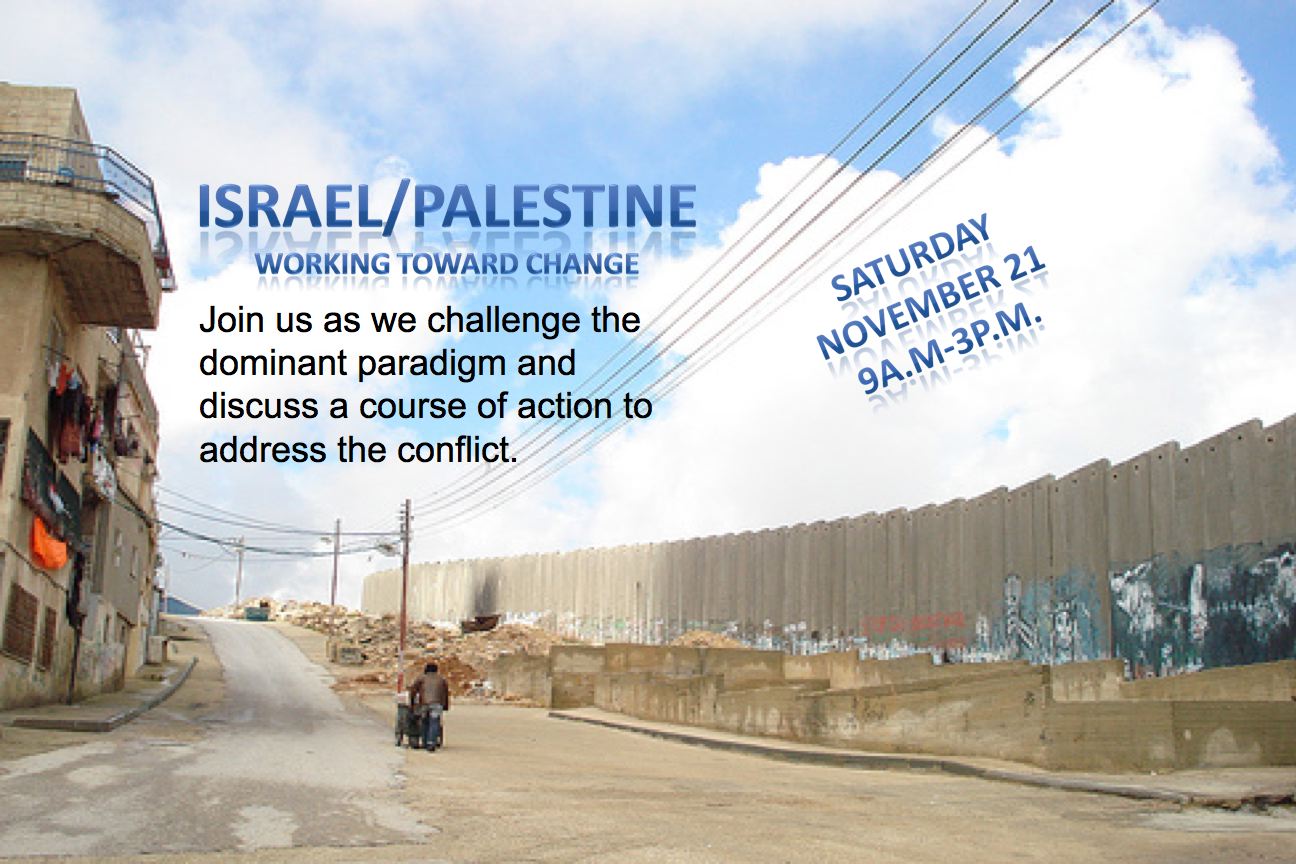
Conference: Israel/Palestine: Working Towards Change (Nov 21st)

Join us as we challenge the dominant paradigm and discuss a course of action to address the conflict.

November 21st at the Friends Meeting House, 1802 East 1st St, Duluth, MN

Conference Schedule

9a.m.-9:15 Welcome with Session I Moderator Mary B. Newcomb
 
9:15-11 a.m. Session I: Challenging the Dominant Narrative – Joel Sipress, Bret Thiele, Mayra Gomez
 
11:15-Noon Session II, Part One: Vocalizing Concerns, Moderator: Carl Sack

Lunch Provided

12:30-1:30 Session II, Part Two Workshop

11:45 -3PM Session III: The Activist Plan, Moderator: Bob Kosuth

Contact Information
Bob Kosuth: 724-4800
Jay and Mary B. Newcomb: 724-6141
Bret Thiele and Mayra Gomez: 525-5609
Joel Sipress: 724-4624


View Larger Map

SHARE THIS

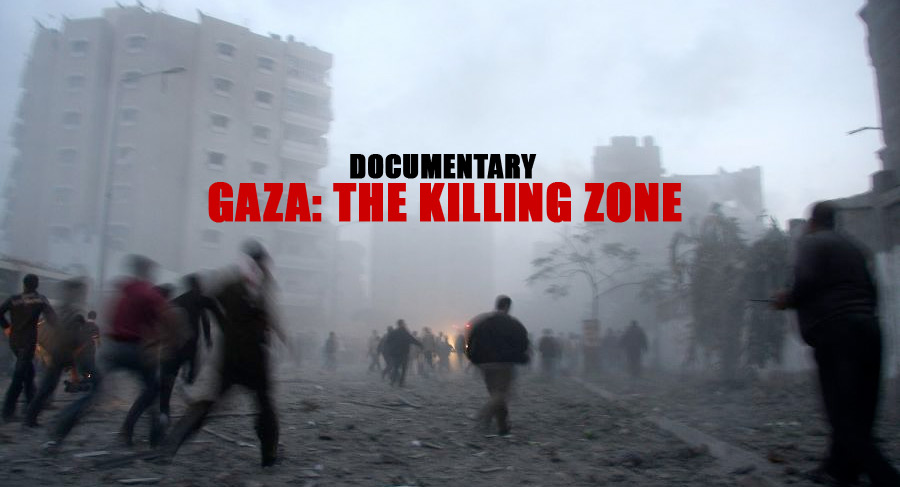
Documentary showing: “GAZA The Killing Zone” (October 16th)

Friday October 16th @ 5:30pm

Film Showing: “Gaza: the Killing Zone.” A British documentary on Israeli violence in Gaza against not only Palestinian civilians, but international aid volunteers and foreign reporters as well.

Bob Kosuth will be talking about the Israeli-Palestinian conflict at 6:30pm.

The film showing is part of “Remember the Refugee Week”, sponsored by Amnesty International, St. Scholastica.


View Larger Map

SHARE THIS

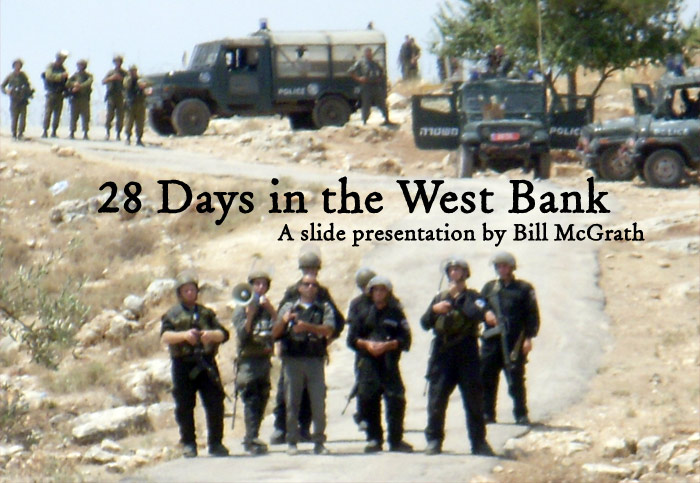
Series of three slideshow presentations by Bill McGrath (Oct 18th, 25th, 28th)

Bill McGrath lived with an Arab Palestinian family, and walked around in Nablus, Jericho, Bethlehem, Hebron, Jerusalem, Jenin, Ramallah and the Negev Desert of southern Israel.

McGrath is giving a series of talks to persuade Americans to go see the Israeli-Palestinian conflict for themselves.

Sunday, October 18th
10:15 a.m. at Pilgrim House Unitarian-Universalist church in Arden Hills.

Sunday, October 25th
10:30 a.m. at the St. Cloud Unitarian-Universalist fellowship in St. Cloud.

Wednesday, October 28th
7 p.m. at Unity Unitarian Church in St. Paul.

SHARE THIS

Iran: the wrong nuclear threat in the Middle East?

By Sylvia Schwarz, MinnPost, 7 October 2009

We’ve heard a lot recently about the evil of Iran and its government, about President Mahmoud Ahmadinejad’s denial of the Holocaust, about how he stole the election, and about the grave threat to the world his nuclear facilities are. In July 2007 Shimon Peres, Israel’s president, said Ahmadinejad “worship[s] the bomb more than he’s worshipping God in heaven.” This statement may have helped to whip up opinion among fundamentalists of all religions against Iran’s nuclear ambitions, but it did little to allay skeptics’ questions about the real nuclear threat in the Middle East.

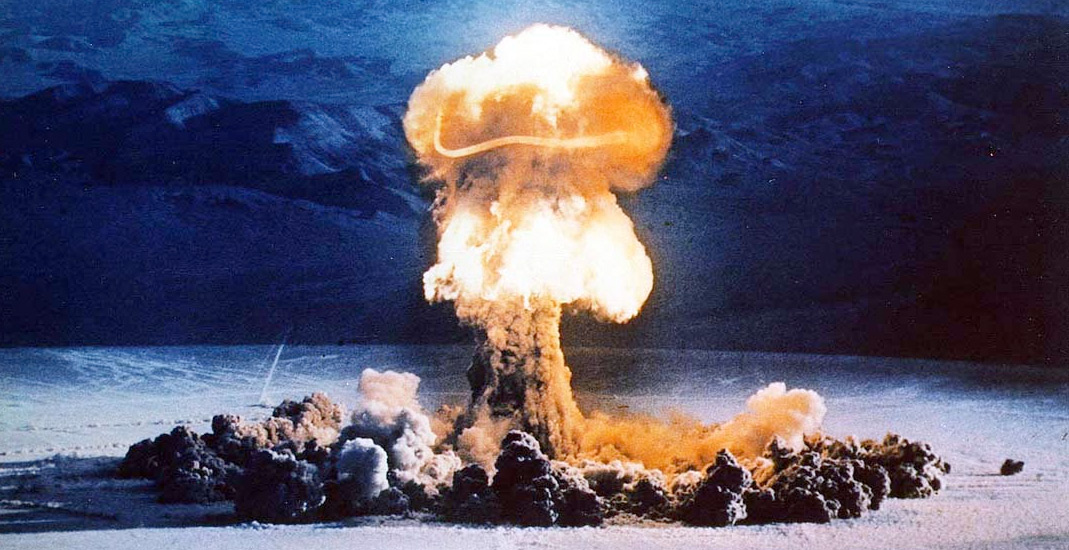
Since the beginning of Iran’s nuclear program, Iran has been a signatory to the Nuclear Non-Proliferation Treaty. Israel has not. Iran has allowed International Atomic Energy Agency (IAEA) inspectors into its facilities and complied with all the requirements of the IAEA. Israel has not. In fact, Israel’s nuclear weapons are still a “secret.” Mordechai Vanunu, an Israeli nuclear technician, spent 18 years in prison there after revealing aspects of the secret program to the British press.

By all accounts, Iran perhaps could produce one nuclear bomb per year, and might have one now, which is untested. According to Seymour Hersch in “The Samson Option,” Israel already owns more than 200 nuclear weapons, and since that book was published in 1993 Israel certainly has produced more.

Examine the record first
But isn’t it the case that with a loose cannon like Ahmadinejad in power in Iran, there can be no security if Iran has the technology to create any nuclear weapons? There are a lot of loose cannons out there, and there is no doubt that Ahmadinejad is, speaking generously, not well educated about world history. But we should examine the record before accusing him of attempting to sacrifice the Iranian people to nuclear war. Iran has never attacked the United States, Israel, or any European or Arab country.

It is true that Iranian students, with the go-ahead from the government at the time, took American embassy workers hostage for more than a year. And it is possible, though he disputes the claim, that Ahmadinejad was one of those students. Israel has not been so restrained, attacking all surrounding Arab countries in the 1967 Six-Day War, and in what should offend Americans to this day, bombing the USS Liberty, killing 34 American sailors and wounding 171. Since the Six-Day War Israel has attacked Iraq’s nuclear facility (1981), Syria’s nuclear facility (2007), and Lebanon (1982 and 2006), and kept up a brutal campaign of occupation and ethnic cleansing against the Palestinians.

Iran has no freedom of the press, closes down media outlets and persecutes journalists. Israel is known for its free press, yet it also clamps down on dissent. This year Israel confiscated computers and harassed members of New Profile, a peace group in Israel. Israel would not allow any foreign journalists into Gaza before or during its assault there in December, just as it barred journalists into Jenin in 2002 during what human-rights workers and Palestinians called a massacre.

Israel: A democracy for some
Iran recently had a disputed election and is not by any means a democracy. Israel is repeatedly called the only democracy in the Middle East. But its Basic Laws (Israel has no constitution) deny non-Jews many of the rights that Jews alone enjoy, including the right to automatic citizenship at birth, the right to marry and live with one’s choice of mate, and the right to own property. Israel is a democracy for Jews alone, not for all citizens.

Iran has no chance of nuclear parity with Israel. Iran, a huge country to the east of tiny Israel, could never launch a first strike, with Israel’s far superior weaponry and world opinion. Israel, on the other hand, could very easily launch a nuclear strike against Iran, wiping it off the map, and knowing that since the wind blows from west to east, the fallout would be well diluted before it made its way back to Tel Aviv. Given Israel’s history with world opinion, there would be no fallout on that stage either. Iran rightly believes that Israel poses an existential threat to Iran, not the other way around.

Since Iran could never expect protection from the world, it feels it should be allowed to protect itself from Israel.

Sylvia Schwarz, a resident of St. Paul, is a member of the Coalition for Palestinian Rights (CPR) and the International Jewish Anti-Zionist Network, Twin Cities (IJAN-TC).

SHARE THIS

5 years after the International Court of Justice decision against the Wall

Mondoweiss, July 9th—Today marks the five-year anniversary of the International Court of Justice’s advisory opinion which found Israel’s Separation Wall in the West Bank to be “contrary to international law.” Although the Court called for Israel to cease construction, dismantle the parts of the Wall that had already been built, and offer reparations for damages caused, none of this has been done. Instead, Israel has continued to build the structure which effectively annexes Palestinian land and furthers the Israeli colonization of the West Bank.

The UN has recognized the five year anniversary by demanding that Israel implement the ICJ ruling. Oxfam UK has marked the occasion by releasing a new scathing 30-page report – Five years of illegality: Time to dismantle the Wall and respect the rights of Palestinians. Jeremy Hobbs, Executive Director of Oxfam International, explains how the inability of the international community to respond to the Court’s opinion puts the entire peace process in doubt:

“For five years now, different Israeli governments and the international community have turned a deaf ear to the appeals by the General Assembly of the United Nations and have refused to respect and observe the opinion of the International Court of Justice. This inaction gives the wrong signal: that international law can be violated without accountability. For the sake of Palestinians and Israelis alike, it is time for the rule of law to triumph. If not, it will be very difficult to achieve a just, negotiated, and durable peace in the Middle East”

But today is not only the five year anniversary of the ICJ opinion, it is also the four year anniversary of the Palestinian civil society call for Boycott, Divestment and Sanctions (BDS) against Israel. The call for BDS was initiated after watching a year of inaction among the international community to the ICJ opinion. It was quickly obvious that Palestinians would not be able to rely on other governments to hold Israel accountable, even with the ICJ opinion. Instead, it would be left to civil society to leverage the power they have, even if it’s just on a personal level. The Bethlehem-based BADIL Resource Center for Palestinian Residency and Refugee Rights issued a statement on the fifth anniversary of the ICJ ruling, both to mark the anniversary and to renew the call to hold Israel accountable. From the statement:

The ICJ ruling should have been a victory for the forces demanding respect for and implementation of international law. Instead it has become a symbol of Israel’s disrespect for international law and of the international community’s failure to hold Israel accountable to its crimes; despite the devastating consequences such impunity has upon the lives of Palestinians who continue to be displaced from their homeland.

The wall has definitively created six ghettos throughout the Occupied Palestinian Territories containing 98 enclaves with 312,810 Palestinians surrounded by barbed wire, walls and control towers. At least 14,364 persons have been displaced in the 145 localities through which the wall passes with some 90,000 Palestinians directly threatened by displacement as the Wall’s construction is completed.

Without recourse to an adequate non-partisan mechanism to implement the ICJ ruling, Palestinians are left with few options to defend their rights and to resist displacement. While weekly grassroots protests continue in villages like Bil’in, Ni’lin, and Ma’sara whose lands continue to be robbed, they have so far lacked the sufficient leverage to resist Israel’s sheer military might and the accompanying impunity provided Israel by the international community.

In this context, there is no substitute to advancing the broad, international civil society struggle to boycott, divest and sanction Israel as called for by Palestinian civil society since 2005. Such a campaign has the moral authority and power to counter balance the forces supporting Israeli apartheid. Those who pay taxes to governments that support Israel; those who handle Israeli products whether as vendors or consumers; and those who engage in international academic, cultural and sports fora that normalize Israel’s regime of occupation, colonialism and apartheid – all have within their hands the power to stop the machine that makes Israeli apartheid politically viable and materially profitable.

Four years later, the BDS movement is quickly growing. Today is a useful reminder of why it’s necessary.

  • Visit Mondoweiss
  • SHARE THIS

    Slingshot Hip Hop @ Bedlam on July 19th

    Sunday July 19, 9pm
    on the Bedlam Theatre rooftop deck
    1501 S. 6th Street, on the West Bank, Minneapolis

    an outdoor viewing of Slingshot Hip Hop

    Slingshot Hip Hop is the first feature-length documentary about the Palestinian
    hip hop movement. At the cutting edge of this emerging Middle Eastern youth
    it is a fresh, complex and energizing window into contemporary life in
    Palestine and Israel, and into one of the many identities that Arabs are exploring
    today.

    These events are free of charge (donations gladly accepted) and brought to you by
    the International Jewish anti-Zionist Network, Twin Cities (IJAN-TC)
    For more information on the network, ijsn.net
    For more information on the events, ijan.tc@gmail.com

    SHARE THIS

    Anthropologist, author and feminist Smadar Lavie to speak on July 15th

    June 29, 2009–IJAN-TC presents Anthropologist, author and feminist Smadar Lavie in a talk “Mizrahi Jewish Feminism and the Question of Palestine” at the Bedlam Theatre, 1501 S. 6th Street, Minneapolis, MN (on the West Bank), Wednesday, July 15, 2009, at 6:30 pm.

    Smadar Lavie is a Mizrahi Jew, born and raised in Israel. She is the author of the academic bestseller, The Poetics of Military Occupation (1990, University of California Press) and several other books and articles. She is the co-founder of the Feminist of Color Movement in Israel, the Coalition Against Apartheid in Israeli Anthropology, and other feminist and anti-racist NGOs.

    For the last two years she held the Hubert H. Humphrey Distinguished Visiting Professorship in Islam and the Middle East at Macalester College in St. Paul. She is completing a book on the relationship between the Mizrahim, Palestine, and the racial formations of Israel.

    Join us for an exciting discussion about a facet of Israeli society that is not well known in this country and how it relates to Palestinian/Israeli issues.

    For more information on IJAN; http://www.ijsn.net

    SHARE THIS

    Lecture: Social and Ethnic Divisions Among Israeli Jews and the Politics of Palestine

    On June 13th about 35 folks gathered at the Friends Meeting Hall in Duluth to hear a presentation by anthropologist and feminist Dr. Smadar Lavie, Hubert H. Humphrey Distinguished Visiting Professor of the Islamic World and the Middle East at Macalester College. To do complete justice to all she covered would be impossible, so let me focus on just two major aspects that are likely to be new to many readers–the nature of the Mizrahim population and why it has pushed Israeli politics to the right.

    The Mizrahim are Jews whose origins are North Africa and the former Ottoman Empire margins of Europe. They make up 63% of the Jewish population of Israel and 50% of the total population of the state of Israel when one includes the Palestinian citizens of Israel. Though the majority, they are generally socially and economically at the bottom of Israeli society. On the other hand, the Ashkenazi Jews from Eastern and Central Europe, though numerically a minority, form the economic and cultural elite of Israeli society and represent the familiar European face of Israel typically seen by the rest of the world.

    From 1948 till the present, the Mizrahim have been settled in the border zones of Israel by the politically powerful Ashkenazim. The Ashkenazi right wing’s policy of settlements has been a boon to the economically disadvantaged Mizrahim, who have received good affordable housing and other benefits in return for their political allegiance to the right. Thus, they have been the major contributing factor to the rightward drift of electoral politics. According to Lavie, the Mizrahim are considered “true Israelis” only when they become cannon fodder on border zones or pawns to replace expelled Palestinians in order to make impossible their legitimate right of return.

    The ultimate irony is that, being of Middle Eastern origin and economically disadvantaged, the Mizrahim have the greatest potential for dialogue–if not coalition–with the Palestinian citizens of Israel and Palestinians at large. It’s their manipulation by the elite Ashkenazi minority that prevents this. Netanyahu’s current government is only the latest manifestation. In Lavie’s view, putting the Mizrahim in settlements is not unlike the movement of poor landless Scots to Northern Ireland by the British.

    Much more could be said and sadly I have not at all covered the complexity of how feminism within the various groups figures in the equation. Mizrahi feminism is inspired by US feminists of color while Ashkenazi establishment feminism reflects the limitations of their class status.

    Given the circumstances, Professor Lavie’s conclusion is that the clock is ticking on a just solution to the problem of Palestine. For her, a just and lasting peace would only be accomplished through a secular one-state solution because only such a state could encompass all the social class, religious and cultural variation within Palestinian, Mizrahi and Ashkenazi cultures.

    In any case, no solution is possible without an understanding of the social class, economic and power disparities between Ashkenazi and Mizrahi Jews. Potential US or European intermediaries have to speak directly to the concerns of the Mizrahim and not just talk to their Ashkenazi manipulators.

    T o say the least, the challenges are daunting.

    Bob Kosuth, Duluth MN BBC, rkosuth [at] hotmail.com

    Related Links

  • Sacrificing Gaza to revive Israel’s Labor party, Smadar Lavie, The Electronic Intifada, 19 January 2009
  • SHARE THIS

    Divest for Justice in Palestine!